

Missing teeth can affect much more than your appearance. They can make eating difficult, change the way you speak, and even affect your confidence. Fortunately, modern dentistry offers several effective ways to restore your smile. Two of the most common treatments are Cosmetic Bridges and Dental Implants.
If you are unsure which option is right for you, a qualified Dentist can explain the differences and help you choose the treatment that fits your needs, budget, and long-term goals.
What Are Cosmetic Bridges?
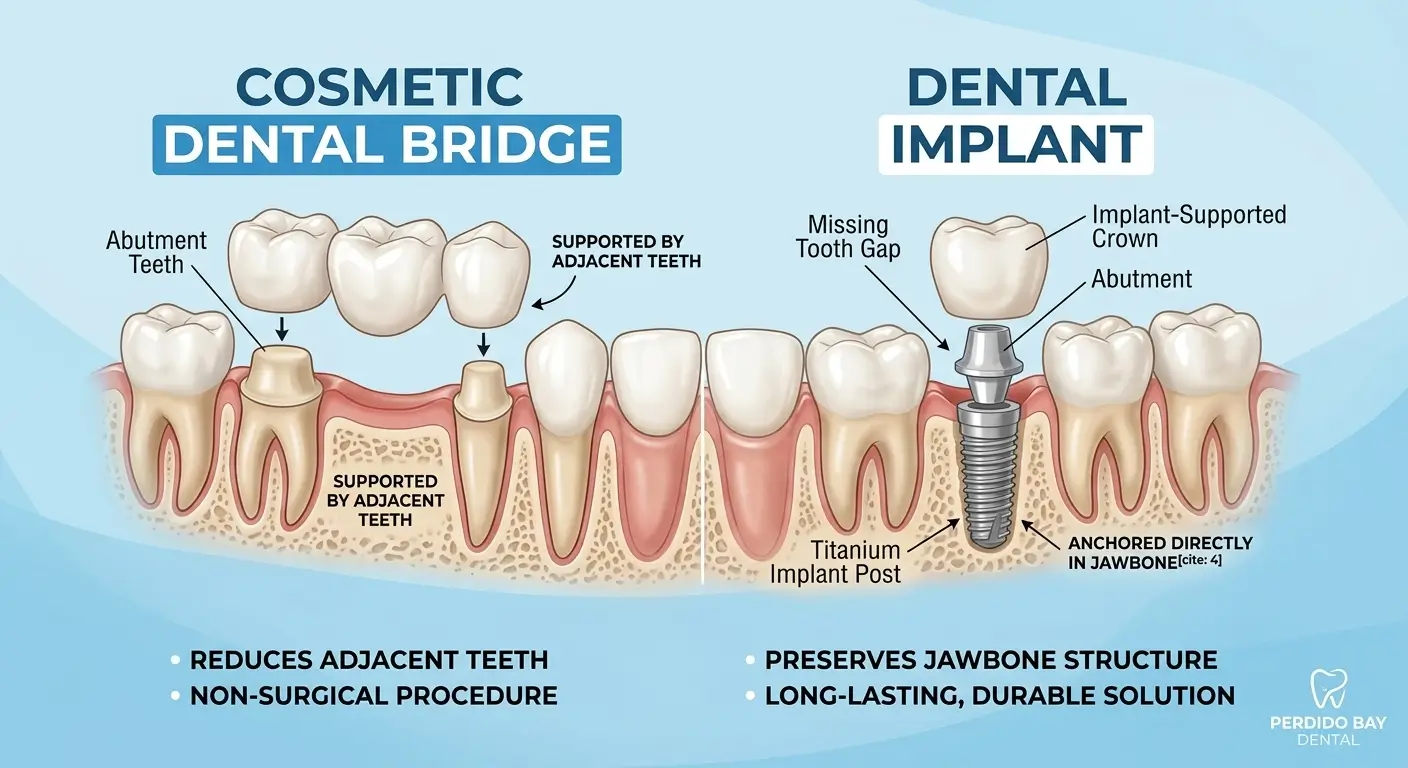
Cosmetic Bridges are designed to replace one or more missing teeth. They work by attaching an artificial tooth to the healthy teeth beside the gap. These supporting teeth help hold the bridge securely in place.
Many people choose cosmetic bridge teeth because they look natural and can often be completed in just a few dental visits. The replacement teeth are carefully matched to the color and shape of your existing teeth, making them blend in with your smile.
Advantages & Limitations
Cosmetic bridge teeth offer several advantages:
- They restore your smile.
- They improve chewing functionality.
- They help prevent nearby teeth from shifting into the empty space.
- Since no surgery is required, many patients find the process straightforward.
One limitation is that the supporting teeth usually need to be reshaped before the bridge can be placed. Your Dentist will explain whether this is the best option for your situation.

Understanding Dental Implants
Dental Implants replace both the visible tooth and its root. A small titanium post is placed into the jawbone, where it acts like the root of a natural tooth. After the area heals, a custom-made crown is attached to complete the restoration.
Many patients choose implants because they feel and function much like natural teeth. They are also known for their durability and long-term success.
People who have lost many or all of their teeth may also be candidates for full dental implants. Instead of replacing every tooth individually, several implants can support an entire arch of replacement teeth.
Comparing Cosmetic Bridges and Dental Implants
Both treatments have distinct benefits, and the right choice depends entirely on your individual needs.
Cosmetic Bridges are often recommended when:
- The teeth beside the gap already need crowns.
- You prefer a treatment that does not involve surgery.
- You want a shorter treatment timeline.
Dental Implants are often recommended when:
- The surrounding teeth are healthy.
- You want a long-lasting, permanent solution.
- Your jawbone is healthy enough to support an implant.
- You are considering full dental implants for multiple missing teeth.
Although Dental Implants usually require a longer treatment process, many patients appreciate the added stability and natural feel they provide.
Cosmetic Crowns May Also Be an Option
Sometimes a missing tooth is not the primary problem. Instead, a damaged tooth can be restored with Cosmetic Crowns.
A cosmetic crown is a custom-made cap that covers a damaged tooth. It strengthens the tooth while improving its overall appearance. Crowns are commonly used after large fillings, root canal treatment, or when a tooth has cracked or become badly worn.
Your Dentist will examine your teeth to determine whether a crown, bridge, or implant is the most appropriate solution.
Making the Right Choice
There is no single treatment that works perfectly for everyone. Factors such as your oral health, budget, lifestyle, and personal preferences all play an important role.
During your consultation, your Dentist will carefully evaluate your teeth, gums, and jawbone before recommending a tailored treatment plan. They will also explain the expected timeline, recovery process, and long-term care required for each option.
Final Thoughts
Today’s dental technology gives patients more choices than ever before. Whether you choose Cosmetic Bridges, cosmetic bridge teeth, Cosmetic Crowns, Dental Implants, or full dental implants, the goal is exactly the same: restoring a healthy smile that looks natural and functions comfortably.
Scheduling a consultation with an experienced Dentist is the first step toward finding the treatment that best fits your smile and your future oral health. during the night. This intense pressure creates terrible aching feelings throughout the entire jaw the very next morning.